 In Five Years
Load Bearing
In Five Years
The friendship with her opposite is the relationship the novel is actually about, and what these two owe each other is the whole breaking heart of it.
Your choice is saved on this device. Sign in to sync it across devices.
Trope guide
There are seven people around a table that seats six, and three of them are related to each other, and the arrangement has been in place long enough that nobody remembers agreeing to it. Found family is a form in which a chosen group functions as the emotional…
Riley Locke definition
There are seven people around a table that seats six, and three of them are related to each other, and the arrangement has been in place long enough that nobody remembers agreeing to it. Found family is a form in which a chosen group functions as the emotional centre alongside the romance, and it has become one of the strongest commercial currents in the genre for a reason worth naming: a great many readers want the couple and the group, and would take the group alone. What the form promises is belonging that was elected rather than inherited. Biological family arrives without consent and is frequently the source of the wound the book is treating. A found family is assembled, which means every member is there because somebody chose them and keeps choosing them, and the reader gets to watch that maintenance. The make-or-break element is whether the family costs anything. That is the test and most versions skip it. A group that provides support, banter, and a place to sit is a friendship circle serving as scenery. A family makes demands. It has claims on time and loyalty that compete with the romance. It has a member who is difficult and cannot be dropped, because that is what family means. It has an internal politics that predates the heroine and does not rearrange itself for her convenience. The failure mode is the applauding chorus. The group exists to endorse the relationship, to tease affectionately, and to appear at the climax being pleased. Nobody in it has an interest that conflicts with the couple's. The reader has been given a laugh track. There is a second failure worth naming, which is the exclusion problem. Found family narratives are about being let in, so a book that lets its heroine in without friction has skipped the subject. The strong version has somebody who does not want her there, for reasons that are not stupid, and the earning of that person is frequently more satisfying than the romance. The form pairs with certain shapes naturally. Motorcycle club, small-town, restaurant and kitchen, military unit, band, and the interconnected series where each book promotes a different group member. That last pairing is close to a business model, because a found family generates its own sequels: every member is a future protagonist and the reader has already met them. The strongest versions understand that a found family is not a replacement for a broken one but a different thing entirely, and that a character can have both. The book that lets its heroine keep a complicated mother and a chosen group at once has more to work with than the book that requires her to choose. There is a craft difficulty the form imposes that writers frequently underestimate. An ensemble competes with the couple for space, and a book that gives its group enough room to earn the label has less room for the romance than a two-hander does. The strongest practitioners solve this by making group scenes do double duty, so that every dinner is also a scene about the relationship, observed by people with opinions about it. Somebody moves the seventh chair without being asked. Nobody comments. That is the form. Not the group, but the fact that every one of them stays on purpose.
Books with published reasons
Each reason belongs to the book record. Open the book page for the full summary, content guidance, edition identity, and related claims.
In Five Years
The friendship with her opposite is the relationship the novel is actually about, and what these two owe each other is the whole breaking heart of it.
 A Court of Wings and Ruin
A war too large for one household to repair forces a family to build coalitions, so allies arrive with grudges and prices attached.
 A Thousand Splendid Suns
Two wives installed as rivals in one household convert that antagonism into the fiercest alliance available anywhere, assembled under siege rather than chosen.
 Parable of the Sower
A theology drafted in notebooks gets tested on whether it can hold strangers together under pressure, which makes belief and household a single engineering problem.
 Network Effect
Length buys a household with internal politics rather than a group to be defended, and the volume spends it on people who worry about each other out loud.
 The Galaxy, and the Ground Within
Four strangers and a host build something in three days that none of them arrived wanting, and the book argues that proximity plus courtesy is most of how it happens.
 Wedding Crasher
A Brazilian-American household turns up as a complete cast with verdicts and baking, and its rulings outweigh every professional calculation either lead has made.
 To Have and to Heist
A nervous hacker, a driver with a temper and a network of aunties conducting reconnaissance supply the jokes and the operational capability in equal measure.
 Station Eleven
Musicians and actors crossing the lake towns cohere around a shared repertoire rather than around blood, and that repertoire is what proves staying alive is not enough.
 The Guernsey Literary and Potato Peel Pie Society
A book club invented on one night to explain away a forbidden meal outlasts the occupation that prompted it, which is a stranger genesis than fondness usually manages.
 Leather & Lark
People bound by mutual knowledge of exactly what each has done is a stranger arrangement than affection, and two volumes have been quietly assembling it.
 A Court of Frost and Starlight
A household assembled from survivors keeps performing its rituals while one member quietly stops attending, and the performance is what makes the absence legible.
 Empire of Storms
Pairing off nearly the whole cast converts an army into a household that happens to be at war, which reorders what the plot is even for.
 A Court of Silver Flames
Three women who owe each other nothing build something out of shared training, and the novel weights that friendship as heavily as it usually weights a bond.
 Kingdom of Ash
Five separated groups each carrying a siege of their own means the household is distributed rather than gathered, so reunion becomes the unit of payment.
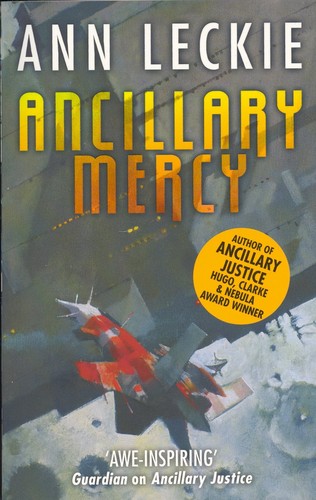 Ancillary Mercy
Being noticed by people who were never ordered to notice is the reversal this volume runs on, and a crew that pays attention unasked is the trilogy's quiet answer.
 Ancillary Sword
An officer collecting people the empire declined to count builds a household out of a chain of command, which is the only shape available to her.
 A Closed and Common Orbit
A shuttle intelligence brought up a child nobody else would take, and the sequence's question about what a machine is owed starts there without ever being announced.
 Final Strife
This is fantasy about stratification that never mistakes worldbuilding for endorsement, and its revolution runs on training montages, found family, and the quietly radical act of teaching someone how to run.
 Lovelight Farms
Borison keeps the antagonists small, weather, ledgers, one condescending bank officer, and spends the reclaimed space on texture: pine sap and hot cider, the farmhands as found family, a town that shows up.
 One Last Stop
Anyone who has fallen for a stranger on a commute, readers who want their romance carrying history without homework, and every found family still assembling itself.
 The Long Way to a Small, Angry Planet
a crew whose obligations to each other are the plot rather than the backdrop
 Dungeon Crawler Carl
a group that makes demands on him, including ones he would prefer to refuse
 We Are Legion
Graph connections
These are co-occurrences across the books above, not claims that the terms are interchangeable.