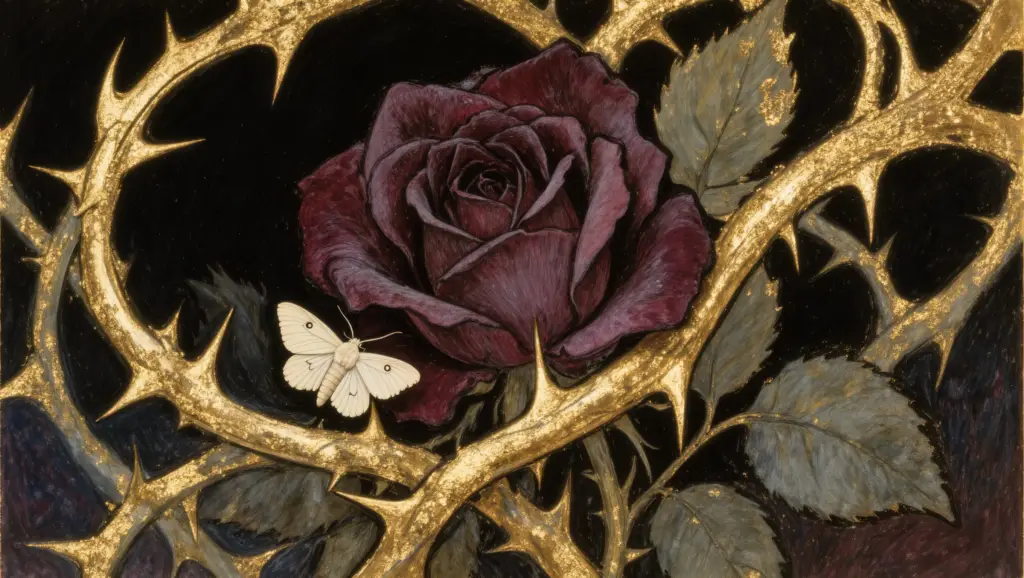
There is a particular kind of reader who finishes a chapter, sets the book down, notices their own pulse doing something, and thinks: again. Dark romance is written for that person. It is the genre you reach for when a sweet story about two people falling in love over sourdough is not going to cut it — when you want the falling-in-love kept, and everything around it quietly wired to alarm.
The pleasure is hard to explain to people who do not read it, mostly because explaining it out loud makes you sound like you need a chat with someone. You are wrapped in a blanket with a cup of tea going cold beside you, and on the page a man is doing something that would end a real relationship and possibly require a lawyer. You reach for a biscuit. This is fine. This is, as it happens, the entire point.
Dark romance is a haunted house you can close. The fear is real enough to feel and false enough to be safe, and the safety is the whole architecture: there is a back cover, and you can reach it whenever you like. Horror offers you the same bargain without promising that anyone will be loved at the end of it. Dark romance keeps the promise. That is the trade — you agree to be unsettled, and the book agrees that underneath all of it, this is still a love story. You are never in any danger. You are just renting the feeling.
A word on content warnings, because they matter more here than anywhere else in fiction. In most genres a content warning is a stop sign. In dark romance it works more like an ingredients list — readers check it to find the book that has what they are after, not to avoid one. That does not make it optional. Know your own lines, read the warnings, and believe them when they tell you where a book is going. The genre is unusually generous with them precisely because it travels to places the others do not.
None of this is new, incidentally. Emily Brontë handed the English canon a man who digs up his dead beloved, and we put it on school reading lists and called it a classic. We were simply quieter, once, about enjoying that sort of thing. The books below are not quiet about it.
I have sorted them by roughly how far off the edge they go, so you can find your own altitude and stay there, or climb.
Start here if you are dark-curious
These are the shallow end. Dark in temperature more than in content, with a hero who is emotionally unavailable and vaguely dangerous rather than a genuine cause for concern. A safe first step, and a good way to learn whether the feeling is one you want more of.
Twisted Love by Ana Huang
Alex Volkov is cold, precise, and carrying a past he keeps behind glass. He is the brother’s best friend made of ice, and the novel is the slow business of the ice going somewhere. It is the gateway drug of the genre for a reason: the danger here is atmospheric, the hero more withholding than frightening, and you can finish it without needing to lie down. Most people who read it come away wanting something with sharper teeth. That is the book doing its job.
Hooked by Emily McIntire
A Peter Pan retelling in which James — yes, that one, the captain — sets out to seduce his enemy’s daughter as an instrument of revenge, and finds the instrument developing opinions of its own. This is the villain-was-hot-and-had-reasons school of dark romance, and it is enormously satisfying, because a story you already know is a wonderful thing to have turned inside out. There is a whole shelf of these fairy-tale reversals waiting if it lands for you. I will not make the obvious pun about being caught by it. You are welcome.
Committed, but keeping your composure
You have decided you like this. Good. These go further — the stakes sharpen, the heroes get properly difficult, and the danger stops being purely a mood. You will still be able to make eye contact with your book club.
Corrupt by Penelope Douglas
This is more or less the blueprint the modern bully romance was traced from. Masks, revenge, a group of young men with too much money and a grudge with a long memory, all rendered in a hot, humid atmosphere of things about to go wrong. It taught a great many people how the genre works — how revenge can function as a kind of courtship, how a mask lets a character be honest. Intense, but built on solid bones. You always know why everyone is behaving appallingly.
The Sweetest Oblivion by Danielle Lori
The mafia dark romance to hand someone who wants the genre at its most elegant. Elena’s younger sister is the one arranged to marry the Don, Nicolas Russo, which would be manageable if Elena could stop wanting him herself. The whole novel is the tension of that pull refusing to be talked out of, across a run of engagement dinners where the man across the table is meant to become her brother-in-law. The danger stays mostly in the air here — family, obligation, the weight of a wedding nobody should be tempted to ruin — and the restraint is the point. It is a slow, well-tailored ache, and it wears a very nice suit while it happens.
Butcher & Blackbird by Brynne Weaver
Two serial killers who hunt other serial killers meet, form a competitive little friendship, and fall for each other over a shared hobby that does not bear describing at a dinner party. Here is the thing nobody warns you about dark romance: it can be funny. This book is proof. It is openly, deliberately comic, and it works because the wit and the body count are both played straight — the jokes never soften the horror, and the horror never mugs the jokes. Pulling that off is a high-wire act, and this one crosses without looking down. If someone has told you dark and funny cannot share a page, hand them this book.
The deep end — read the warnings, and mean it
Everything above was a warm-up. These are the books people mean when they lower their voices. They are extremely dark, the content warnings are long, and I am going to keep repeating that they are load-bearing, because they are. This is where knowing your own limits stops being a formality.
Haunting Adeline by H.D. Carlton
The one most readers now picture when they say the words “dark romance.” Adeline inherits her late grandmother’s gothic mansion in Seattle and discovers she has a stalker, and that she is not the first woman in her family to be watched from the shadows. It is the book that turned the subgenre into a full cultural event, complete with an ongoing argument about it that has more or less its own postcode. It is also extremely dark, with warnings as long as some novels. Read them. This is not a book you back into.
Credence by Penelope Douglas
After loss leaves her adrift, Tiernan is sent to a remote cabin to live with her late father’s stepbrother and his two sons, and the isolation does exactly what isolation does. This is taboo, close-quarters, and a great deal snowier and more claustrophobic than anything before it. The small cast and the nowhere-to-go setting are the engine. Check the warnings before the snow starts falling.
Den of Vipers by K.A. Knight
The bottom of the reverse harem pool. Four dangerous men, one debt, and a heroine handed over as collateral — the premise is ownership, and the book means it. This is not a toe-dip in any sense. The warnings here are not decorative and the intensity is the entire proposition. Go in knowing that, or do not go in.
Captive in the Dark by C.J. Roberts
Worth knowing where a great deal of this comes from. One of the genre’s originating texts, a kidnap-for-revenge story that helped carve out the whole dark, morally impossible space these newer books now live in. It is devastating, it is not for everyone, and it has the decency to be honest about both. Think of it as the root system under the shelf — older, gnarlier, and responsible for more than it gets credit for.
Why we do this to ourselves
Here is the warm truth under all the raised eyebrows. Dark romance lets you hold fear at exactly arm’s length — close enough to feel it move, far enough that it can never reach you — and then it does the thing horror will not, and loves someone through it anyway. It is control over the uncontrollable — rehearsed in a place where the stakes are made of paper. You get to be unsettled on purpose, with your hand already on the exit, and you get to watch someone be chosen in the worst imaginable circumstances and choose back.
That is not a strange thing to want. It is one of the oldest things we want. We just used to be quieter about it.
New guides, reviews, and dispatches from inside the genre land twice a month. Subscribe, and I will keep reading the unsettling ones so you can find your next favourite.